Showing posts with label FAQ. Show all posts

Tuesday, 8 March 2016

Planning ATrip

Planning trips are the foundations of any good journey. Travel Logistics, country visas, Accommodation, Vaccinations, costs, city attractions, travel highlights, and culinary attractions all need to be compiled together to construct a bad ass plan.
The trip can be categorized into 4 different categories:

Domestic Travel
International travel one city in one Country
International Travel multiple Cities in one Country
International travel Multi Cities & Multiple Countries

You can read more about the 4 categories here.

So the process usually goes in the following 4 stages:

Planning breakdown

Location Analysis

Travel Logistics

Click for Airlines Ratings

Cost Analysis

Click for Cost of Living link

Accommodation Logistics

Similar Travel planning articles of Interest:
Visas and Vaccinations
The quick guide to set you on the right track to know if you need a visa or vaccination for a country.
Frequent Flyer Programs & Points
The lowdown on Frequent Flyer Airline programs
Packing Guide
Packing for Holidays 101
Surviving Vacation Illness
Not a "If" but "when" you get sick, one should read this survival tips.

Types Of Trips

A trip can be categorized into 4 different categories:

Domestic Travel:
This is usually the easiest to plan as you are already in the country and most likely the trip will involve a road trip and/or some internal flights. A classic example here would be a road trip to the Grand Canyon from Las Vegas or a weekend trip in Aspen for skiing.

International travel one city in one Country:
This is a very common scenario for Europe where we like to pack up and disappear to a random European city for the weekend. With cheap flights internally a weekend trip in Barcelona or Paris is quite common.

International Travel multiple Cities in one Country:
This is the optimization of your time to learn & see more of a country. An example of this is my trip to Thailand in 2015 which involved landing in Phuket and moving onto Krabi, Railay bay, Ko Lanta, Ko Nhai, Ko Phi Phi Islands, and finishing the trip back in Phuket where I flew out from.

International travel Multi City Multiple Countries:
This is the next level where you want to see and do everything possible in the region. Classic example of this would be my next trip doing Thailand, Myanmar, Laos, Cambodia and Vietnam in one long trip. Alternatively this can be made more complex with a round the world trip which I did in 2012/2013 going from Norway > Spain > Peru > Argentina > Uruguay > Australia > New Zealand > Fiji > Singapore > Norway.

Similar Travel planning articles of Interest:
Visas and Vaccinations
The quick guide to set you on the right track to know if you need a visa or vaccination for a country.
Frequent Flyer Programs & Points
The lowdown on Frequent Flyer Airline programs
Packing Guide
Packing for Holidays 101
Surviving Vacation Illness
Not a "If" but "when" you get sick, one should read this survival tips.

Thursday, 18 February 2016

Travel Index

Here you can find a list of all travel related articles that are linked in the Booking Resources, FAQ and other areas of this blog. A small short cut and overview to help find what you are looking for.

Visas and Vaccinations
The quick guide to set you on the right track to know if you need a visa or vaccination for a country.
Frequent Flyer Programs & Points
The lowdown on Frequent Flyer Airline programs
Packing Guide
Packing for Holidays 101
Surviving Vacation Illness
Not a "If" but "when" you get sick, one should read this survival tips.
Tourist Types I have met
The types of tourists I have encountered on my trips.
The Logistics of Planning a trip
Breakdown and Analysis of all factors.
Types of Trips
Overview of 4 types of trips.
Next Destination
Stay up to date with my current travels

Visas and Vaccinations

Whenever I book a ticket it usually involves the “where” and “when”, followed by a “How” to map the journey. Somewhere along the way the “who” to travel with pops up. Then finally comes the “what” else. The most important part of what else is the V thang: Visas and Vaccinations.

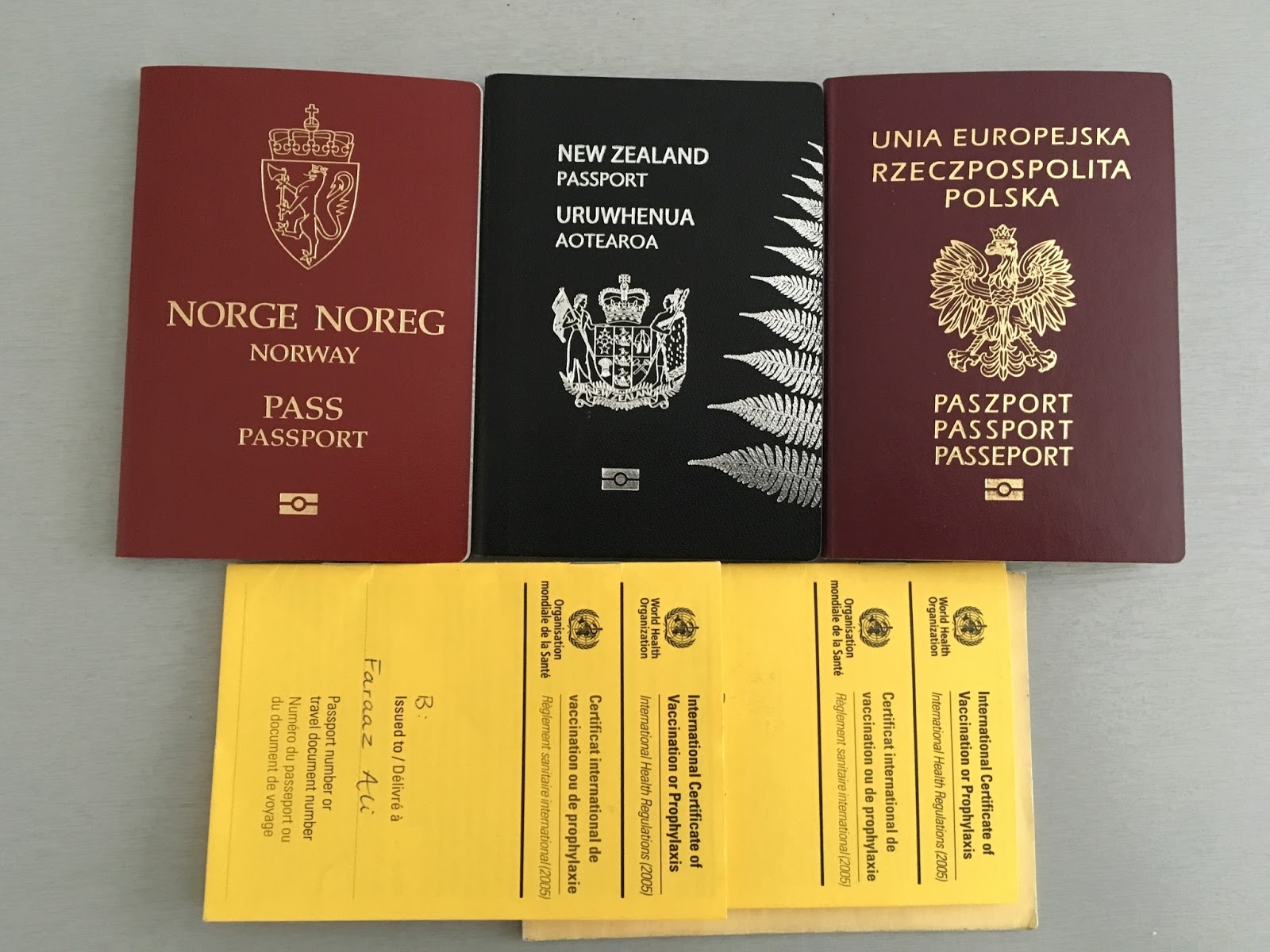
To get entry into most countries these days you need your passport to be valid more than 6 months, valid visa if not exempt, and an International Certificate of Vaccination (That Carte Juane or Yellow card issued by the World Health Organization).

Visa

Passport

Below is the top 30 passport ranking. Having a certain citizenship helps in the long run. The passport power rank helps you evaluate how strong your passport is and the stronger the passport the cheaper it is to travel the world as paying $40-$50 per Visa can add up in the long term.

Travel facts: All passports are categorized under 3 colors: Red, Green, and blue.

Visa Type

The visa type varies for each passport nationality and basically falls under five main categories when it comes to types of Tourist Visas shown below, some countries allow multiple methods as well:

1. Visa required prior to Arrival: These are the stricter countries that require pre-registration of your details before arrival. Visas are often stamped into your passport at the local embassy before travel. Belarus, China, Cuba, India, Russia, Saudi Arabia and Ukraine are good examples here.

2. eVisa/eVisitor/ETA: Some countries need digital registration to enter into a country, it is the equivalent to an ordinary sticker visa into the passport. It is all done via an official government website. When arriving at the destinations passport control, customs can see you have valid entry so they simply stamp your passport and let you pass without the need for a sticker visa. Australia and America are good examples here.

3. Visa on Arrival: : A lot of countries offer visa on arrival which you get for free or purchase at the airport. This forces the traveler to select one of the larger port of entries in the big cities so this rules out border crossing. This often results in large queues at the main airports. To avoid the queues it is wise to visit the local embassy if available to get a visa in advance stamped into the passport. It usually takes 3 days maximum for this.

4. Visa Free/Exemption: : This is when your passport nationality allows your visa free access into a country for a period of 15 days to 3 months. Dependent, Disputed or restricted territories have stricter time frames from 24 hours to unlimited. Best to check the Embassy website for the time period of free entry. Most free visas are single entry.

5. Freedom of movement: This is very common in the Schengen region where moving in the European Union is simply driving across the border or not having to bother with passport controls. Usually if you are coming from outside of Europe your passport is checked at the point of entry and stamped. This is getting stricter now after the Refuge crisis and countries in Europe are enforcing new emergency border controls. Other similar setups are the Economic Community of West African States, Trans-Tasman etc.

How do I check if I need a visa for a certain country?

Best way to start is to simply use the stand alone application below to check if you need a visa.

Visa Checker:

Any other visa tips I should know?

Remember most countries have their own government websites that one can use to pay the Embassy fees only and no third party service fees. For Example, my recent eVisa to Cambodia was done via https://www.evisa.gov.kh/ and Myanmar eVisa via http://evisa.moip.gov.mm/HowToApply.aspx. Make sure the sites are “.gov” to ensure you are at the official Government portal and not an third party agency.

Using the above sites allowed me to save approximately $120 US dollars should I have gone with a third party. Cambodia is an example of a country that offers the option of visa on arrival or eVisa.

Vaccination

While the entry restrictions are enforced mainly in African countries, some Asian countries do check this as well where the travellers agenda involves high risk areas where diseases such as yellow fever are present.

No vaccine is 100% effective, a small percentage of people are not protected after vaccination and for others the protection may wane over time. Also, some people are unable to be vaccinated due to certain conditions such as immune suppression. Maintaining immunity in those around these people protects them from disease.

Do I really need this vaccination?

Getting sick on holiday and in a foreign country is not a position you want to be in. Viral diseases spread by mosquitoes are the main worry and repellents can help but it is not 100%. I have been stuck with dengue fever for a week and that was not fun, a debilitating viral disease of the tropics, transmitted by mosquitoes, and causing sudden fever and acute pains in the joints. If I thought dengue was bad, apparently yellow fever and Malaria are a lot worse causing approximately 30k and 438k in deaths for 2015.

Do you have a vaccination card?

International Certificate of Vaccination (That Carte Juane or Yellow card issued by the World Health Organization). If yes then most of your vaccinations should be listed here so your GP knows which boost is needed. Your GP or Medical Travel center can hook you up with one if needed.

What are the Routine child Vaccines you should have?

• Hepatitis B
• Rotavirus
• DTaP
• Hib
• Pneumococcal
• Polio
• Flu
• MMR (measles-mumps-rubella )
• Chickenpox
• Hepatitis A
• Meningococcal
• HPV

What are the Routine Adult Vaccines you should get?

• Flu
• Td (Tetanus, Diphtheria)
• Tdap (Tetanus, Diphtheria, Pertussis) Boosters to prolong the effects from the child vaccination
• HPV
• Shingles
• Pneumococcal
• Meningococcal
• Hepatitis A
• Hepatitis B

Where can I check which vaccinations I need for a certain country?

I always use this site: http://wwwnc.cdc.gov/travel/

My Doctor is prescribing me Malaria pills for my travels, what side effects should I worry about?

Mylan or Malarone are the recommended ones that do not give you hallucinations.

What precautions should I take to stay safer in addition to vaccines?

Eat and drink safely: Street vendors, salads in any form should be a no go, and any uncooked food items. Unclean food and water can cause problems so cooked food and bottled water is the rule here. Avoid Ice made from tap water as well.

Keep away from Animals: Getting bitten by a Rabies infected animal is best avoided by staying away.

Prevent bug bites: Insect repellent is the main saviour here but there is a list of other measures including clothing, insect smoke coils, drinking apple cider vinegar with water etc..

Germs reduction: Use a hand sanitizer and try to not touch your nose, mouth, and eyes while travelling in a busy spot where your hands have touched things exposed to the wider public.

Avoid NON Sterile Equipment: No tattoos or sharing of anything that looks shady.

Avoid Sharing Bodily Fluids: Avoid saliva, blood, vomit, and semen. Use condoms for Business time if needed and just be careful around people.

Thursday, 11 February 2016

Frequent Flyer Points

When I got round to this first time about 10 years ago it was a lot simpler but things have improved for the better. So all you need to know:

Airline Membership Club:

Each large Airline has its own member club, smaller airlines may not have its own member club but is affiliated to another airlines member club. For example Qantas has a frequent flyer program called “Qantas Frequent Flyer”, Affiliated to this are the following airlines: JetConnect, Jetstar Airways, Qantas Link, and Air Vanuatu. So If I had a Qantas Frequent Flyer number with Qantas, I could collect points with the affiliates as well since it is all part of the same club.

Another example would be Scandinavian Airlines (SAS) with a frequent flyer program called “Eurobonus”. Affiliated to this are the following airlines:Blue 1, and Widerøe. All 3 airlines belong to the same SAS Group so I would collect Eurobonus points flying with either.

Airline Alliance Group:

Each club belongs to an Alliance group. There are 3 main groups of concern: Oneworld, SkyTeam and Star Alliance. Below are 3 images showing all 3 Alliances and the associated members.

One World

Star Alliance

Sky Team

So sticking to the Qantas example I can collect points with Qantas, Qantas affiliates, or Qantas Alliance partner Airlines. In this case the partner airlines are the 14 other airlines in bed with Qantas under the Alliance umbrella “Oneworld”.

Similarly if I was part of the SAS Eurobonus program then I will be able to collect points from Scandinavian Airlines or any of its 27 “Star Alliance” partners.

Which one to Choose?

1: Always choose a Frequent Flyer club that belongs to an Alliance Group.

If you select an Airline that belongs to an alliance that you will have the chance to collect points with your host membership airline and its partners. It will also allow you to spend points with the host airline or partners.

2: Always select one of the big players or your own regional airline to reap the rewards.

Eurobonus is a good example here, it also has Hotel partners and Other partners. What this means is for example is I travel from Oslo to Athens. I will collect 5630 points for the return flight, I will stay at a partner hotel like Radisson Hotel & Resorts and collect 500 points per night, I will rent a car with Avis and collect 1000 points for that transaction, and to top it all I will pay with my American Express card and collect 20 points for every 100 Norwegian Kroners I spent. So I end up collecting a fair amount of points for one trip.

3: You can have Alliance membership with all 3 if it fits your schedule.

The best way to travel is to stick to one Airlines in one Alliance group to maximize the points return. However if you live in a part of the world where getting access to one group is difficult then you should join two groups to be collecting the points.

Membership Levels

The membership tier status levels of each Alliance has a different ranking system:

Star Alliance: Silver◄ Gold ◄ Diamond

OneWorld: Ruby◄ Sapphire◄ Emerald

SkyTeam: Sky team Elite ◄ Sky team Elite Plus

The ones in Bold above is where the magic happens. Lounge access worldwide, Extra baggage allowance, Priority baggage handling are the main benefits among the other small but great gestures/rewards.

The lounge access is the most important to me as the long haul flights can be draining, so having access to warm food, drinks and a bathroom with shower facilities rocks. The other main benefits outside the airport include 2 for 1 tickets bought on points, simple flights bought with points, and using points for free hotel nights.

How much work is it to get to 2nd or 3rd tier Status?

Getting to the higher status is hard work and requires a lot of flights or some long haul flights in a higher ticket class (First or business). Most airlines allow status evolution via number of flights or simply by points earned per flight. Once you are locked into the higher status it becomes easier to earn points. For example as a Eurobonus Gold or Diamond member you earn 25% extra points for each flight. So it is worth it.

Tourist Types

The different types of Tourist I have encountered.

Backpackers: The tourist who usually has the longer trip on average compared to other groups. It is the budget traveler that you will meet at hostels or backpackers. Occasionally at lower end hotels/motels across Asia or home stay at families. This type of tourist are very independent and hardcore after several countries, it takes skills and a strong mindset to live out of a backpack and live absent some comforts we take for granted. The age group for this group is usually teenagers to young adults with the occasional outlier.

Flash packers: This is the next stage in evolution of a backpacker. The back pack is replaced with a suitcase, the accommodation is replaced with hotels. The comforts of life are returned to make the vacation as comfortable as possible. The age group is usually late twenties and up. You can easily find this group in flashy 4-5 star hotels or vacation villa/apartment rentals. They can be further defined into 3 ranges: low end, midrange, high end. All dependent on how much comfort they are willing to splash out on or get sponsored for.

Luxury Packers: This is the next level in evolution from high end Flash packers. We talking private yachts, planes, and drivers for each location. Quite often encountered in Asia and Oceania on some random remote Island. Regulars at luxury hotels in larger cities. Age group can vary from young twenties to pensioners.

Flock Packers: This is a group that is not part of the above tourist evolution process. It is more of a group travelling where the tourists stick to each other like a flock. It is usually large groups where English is not the strongest language combined with very little independent travel experience. Accepting that due to some countries passports and political processes, travelling out of the country is very difficult, therefore group travel is the only option in the long run. The age group can vary here from students to pensioners.

Where Do I fit in my own Scale?

I tried backpacking, but showing up with a suitcase and Ironed shirts when I was 22 years old was a sign that I was not cut off for backpacking. My independent backpacking placed me across dormitories in Fiji, Australia, and Europe over the course of 3 years. By 25 I was ready to hang the backpacking tag and adopt the flash packing lifestyle. There was no turning back after that point.

Vacation Illness

The one thing we all wish to avoid while on holiday. My friends who travel to India usually say it is better to catch the stomach bug on the first few days of the holiday rather than later. Along with the lines I lost 7kg while on vacation. Here are some tips to recover from your most common sickness while on vacation.

Common Cold:

Stuffed nose is quite common, and often accompanied with a cough or worse fever. A nasal spray should be part of the first aid kit with cold and flu tablets to help reduce the symptoms. Acquire a coughing syrup from local pharmacy if is a dry cough but ride it out If it is a progressive cough clearing mucus out. Lots of tea with lemon, ginger and honey. Along with other fluids. Usually lasts 3-10 days.

Altitude sickness:

This is a common problem for hikers. I was taking Diamox on the Inca trail which works fine but one of the side effects is you have to pee a lot. New Studies have shown Ibuprofen was about as effective as current medications to treat altitude sickness, which include prescription-only acetazolamide (Diamox) and dexamethasone, but it doesn't come with as many side effects. That's what makes ibuprofen attractive as a potential preventive for mountain climbers and hikers.

Motion sickness:

This affects a lot of people especially kids and pregnant women. A variety of medications are available to help prevent or treat motion sickness. Medicines for nausea are called anti-emetic drugs. They include antihistamines such as Bonine and Dramamine — available over the counter. A lot of countries have herbal pills and remedies. For example Peru offers Coco leaves as altitude sickness prevention (Which for the record worked very effectively).

Stomach bug:

Diarrhoea or similar is a common case in most countries where the food is foreign to your body and if the hygienic standards are below what you used to, you may get some unwanted action. Best thing to do is ride it out. Usually takes less than 24 hours and you should be on the patch to recovery. Keep electrolyte pills with you to take with water to keep you hydrated and eat lots of crackers/bread.

Poisoning:

Reef fish poisoning or simply bad outdated/prepared food can be a potential threat. Easiest acute treatment is to use activated charcoal tablets. When you take activated charcoal, drugs and toxins can bind to it. This helps rid the body of unwanted substances by throwing up. Charcoal is made from coal, wood, or other substances. It becomes "activated charcoal" when high temperatures combine with a gas or activating agent to expand its surface area. You can buy this from your local pharmacy but please consult your doctor in advance if you have any medical conditions/prescriptions that can cause complications. Do not combine activated charcoal with drugs used for constipation (cathartics such as sorbitol or magnesium citrate). This can cause electrolyte imbalances and other problems.

Prevention is better than Cure:

The good old saying by most Medical Workers & Researchers. So taking the necessary vaccinations or prevention measures are recommended. It may not be 100% effective but it does decrease the chances of getting infected. A good example here of preventive measures is Malaria Pills. Make sure you go for Malarone to prevent any crazy hallucinations that come with the cheaper version of Anti-Malaria drugs.

Packing Guide

A typical case scenario for my trips involve over-packing. It is inspired from the saying, “That it is better to be over prepared than under prepared”. However this is a bad habit when it comes to travelling with luggage as this reduces your mobility and can be troublesome navigating internally with a country.

So after 3 decades of packing experience, the best way to construct your packing is to categorize the different areas and make an excel check list. Cross reference this over the weather conditions, events, people you know, and the holiday type, and you have optimized your resources to some extent.

So let’s list all the important variables:

Weather: Hot, cold, rain, sun, snow, humidity, windy.

Holiday type: City, beach, mountains, skiing, hiking, caves, Adventure, wildlife.

Events: Red carpet, fancy dinner and drinks, clubbing, cocktails, wedding, parties.

People you know: Friends, family, strangers, work colleagues, Industry associates, media/press contacts.

The above should keep most people up all night thinking about what to pack but hopefully this helps.

Section 1: Electronics

Mandatory requirements for any trip is your phone & phone charger. Everything else is a choice based on where you going. Most items will not be even necessary.

  • Laptop +Laptop charger vs Ipad which connects to the same iphone charger
  • GoPro camera + charger + accessories vs Iphone/Android camera functionality
  • SLR camera + charger + lenses vs Iphone/Android camera functionality
  • Electronic toothbrush + charger vs regular toothbrush
  • Hair straightener vs Hair Curler vs Blow Dryer
  • USB battery pack

I have on one occasion carry about 6kg of videography/photography on a 4 day hike that was a very bad idea. So always calculate your travel routes and how much mobility is needed. Most hotels have blow dryers and ladies can book a hairdresser in the local city if additional styling is needed. Holiday type & Events is the main categories here for helping decide what really is needed.

Section 2: Medical Kit

The mandatory requirements for this varies from nothing much except for a mosquito repellent if it is a city break to location specific needs. So most cities or beach holidays have medical centers/pharmacies close by so it is all good. However if you going to a more isolated location or adventurous holiday then the following is recommended:

  • First aid kit (Usual start up kit will suffice for most adventures)
  • Additional painkillers (like Ibuprofen, paracetamol), charcoal tablets, antiseptic cream, band aids, hand sanitizer, Bandages, deep heat spray etc.

Holiday type decides if you need a medical kit or not.

Section 3: Vanity Kit

The mandatory requirements here are the tooth brush, tooth paste, face wash & cream, perfume. Additionally ladies need all the mandatory make up accessories, and hair washing & styling products.

There is no choice here really as most of the stuff you will need at some stage but the trick is to downsize. Most department stores sell travel size plastic bottles and containers. These are perfect to fill up your shampoo, conditioner, hair mask etc. they are all under 100ml so easy for hand luggage as well. You can also pick up hair product samples, make up samples, and men’s grooming samples from department stores so this makes it easy to travel with.

Section 4: Clothes

This is that section where all 4 categories collide & explode, creating this dark cloud from all the smoke and debris. It creates unnecessary stress, confusion, and drama. If you are a man, think twice before passing any answers or Judgment to your significant other regarding packing in this section.

So best way to navigate the packing here is the following questions:

  • 1. How many days/nights are you away?
  • 2. How many locations are you covering during your stay?
  • 3. How many events are you attending?
  • 4. How many outfits/dresses can I reuse in different events/locations?
  • 5. Am I going to a country where I need to cover up because of Cultural/religious set up?
  • 6. Do I need to really impress somebody?
  • 7. Will they have laundry service at the location?

So let’s say for example two couples are going to a wedding in Girona next to Barcelona. The holiday is for 1 week with 3 days in Barcelona, 3 days in Girona and then the final night back in Barcelona before flying out. All friends and family will be in attendance from the Girona part of the vacation. So automatically you have this plan:

  • 1. You need your one main wedding outfit
  • 2. You can use the same long dress, short dress and Bikinis in both locations and no one will really know except for the travelling group of 4. So this reduces your packing of clothes by 50%. Mix and match of trousers/Shirts or Skirts or pants with Blouses is the key here.
  • 3. Hotel in Girona will press the dress and suit for the wedding, do laundry from the few days before.
  • 4. The chances of you meeting some random strangers from Girona and Barcelona in your same clothes are quite rare so don’t worry.

Section 5: Shoes

The weather is the main factor here and flip flops/ runners are usually the front runners for summer, big ass snow boots for winter. All other shoes should be matched accordingly to the outfits planning from section 4. Remember the shoes are easier to match and if all else fails go with black.

Section 6: Shopping Space

The chances of you buying something is quite high if you are on a city break or beach holiday so do make some space for buying new gear. Often all you need is your passport and credit card for a trip, the rest can be optional as you can buy it when away.

FAQ

Where should I go?

This all depends on what you are seeking. Make a bucket list for starters of countries that interest you and then work with that list. Asian holidays during European winter is a good start if you chasing some warmth in between all the ski trips. Exploring further into Africa is the next level if Asia is already crossed off. The world is at your feet so it is all about making the first move.

Where do I go to get good deals for travelling?

The art of finding the perfect deal requires some work but it is not that hard. Use this link for booking resources to find the appropriate website to help locate a good flight, hotel or rental car.

What do I need to pack?

The question that every person asks themselves before each trip. A simple answer here will not suffice as the complexity of packing deserves its own article. Click here for the packing advisor. In most cases we over pack. I have asked female friends to restrict luggage into a hand luggage for a 2 week vacation, I guess after that request I am lucky to still be alive but the good part is luggage content was decreased by 50% from the female travellers. #winning

What happens if I miss my first or connecting flight?

Don’t panic is the number one rule. These things happen and in most case scenarios the airlines are understanding and place you on the next best flight. The important rule is to be polite to the staff as you are in the quicksand and they are helping you. The airline may have delayed the flight but the staff member helping you is not directly responsible so be nice.

Do I need travel Insurance?

Hell yeah. This is a must these days and no one should travel without it. Missed flights, sickness, and accidents are more common than one wants but it is better to be prepared for such an event. I have a few friends who are still alive because they had travel insurance. Most credit card companies have an insurance policy on travel booked on that card but it is wiser to have your own personal travel insurance.

Do I need additional car Insurance from car rental agencies?

When booking a rental car, they offer several excess cover packages. Usually it is a standard coverage or the full protection. The full protection is usually a good idea but some travel insurance companies do cover the standard coverage excess cost you might incur in a car accident, so please check with your personal travel insurance and you might save some money for the full protection. If you have the full protection and are picking up the car, be careful for the up selling tricks by local agents who try to sell you more insurance on top of what you have.

Do I need travel vaccinations?

Hell yeah. This is right up there with travel insurance. Hepatitis A & B, yellow fever, Boosters for measles-mumps-rubella (MMR) vaccine, diphtheria-tetanus-pertussis vaccine, varicella (chickenpox) vaccine, polio vaccine, and your yearly flu shot. Use this site regarding what you need.

What is this Frequent Flyer Club stuff?

You already paid for the flights and hotels so if you had the chance to accumulate points from this activity and reap the rewards down the track then you definitely should. You can read more about points on this link.

What happens if I lose my passport?

Don’t panic. It all depends on which part of the world you are in. Most European, American, Asian and Australasian cities would mean easier access to your local embassy to organize a temporary travel document. If you are stuck somewhere deep like Galapagos Island, try to get to mainland then focus on contacting your embassy.

What important information should I travel with?

Always have photocopies of your passport, driver’s license and travel documents. Try to have a paper copy and not just digital in case you lose your phone as well. Also store important phone numbers like embassy, friends contact etc. on paper. The days of memorizing all numbers is a lost art.

What should I not do in public as a tourist?

This is a tricky one and only gets better with experience. The cardinal rule is never pull out a big ass tourist map in a public square, you are setting yourself up for scam artists looking for easy hustle targets. Try to blend in and pre-planning on how to get to locations within cities helps if you walking. Otherwise take a taxi and don’t buy and wear the “I love Amsterdam” or “I ♥ City” souvenirs.

What do I do when I get sick while away?

It all depends on the sickness. Most common sickness while travelling is stomach bugs, altitude sickness, and the common cold. Your body is stressed from the travelling and the immune system can get weaker. The longer the flight and the further you go the worse the jet-lag. Here is a link on how to survive illness on your trip.

How to stay healthier on your trip?

Drink lots of water with lemon on the trip to retain more water in the body to stay hydrated. Take a good routine supply of zinc, vitamin C and other multi-vitamins before the trip and during the trip to keep your immune system stronger. Also use Insect repellent like it’s the new best lotion, avoiding mosquito bites helps avoid the itching and worse viruses in more critical regions.

What happens if I have an accident while away?

I have been down this road before. Had a quad bike accident in Morocco. Got banged up pretty bad with cuts and rocks/gravel stuck in the shoulder and back. Managed to get to a Bedouin village to get some help cleaning the wounds and getting patched up. Get back on the quad bike and made it to the next village where I needed to be to get to the city. Not everyone has a John Rambo patch up, a friend of mine had a similar bike accident in Dubai. She had to be hospitalized for 2 weeks and flown back to Europe by her travel insurance company once she was stronger. So the most important part is to have travel insurance to cover you away and get you back home safely.

How do I avoid tourist traps?

Time and experience makes you a better traveller and master the art of avoiding traps. I try to mention these in articles so that is a good way to have Intel on different locations. Best advice is to not engage and buy the first deal you are presented on a trip. For example a snorkelling trip in Thailand, the hotel price & deal will be different to the guys selling outside the hotel. So you will need to do some research to see what the price is and where the location is. Based on this research you can make a better decision. Avoid agencies that cater for big Groups as this will be very crowded excursions.

What type of fellow travellers will I encounter?

There are generally 4 categories of travellers I have encountered, you can read about them here. Then there is the scenario they are placed in, for example city getaway, Island Adventure, Jungle hike etc..

Is it safe to travel alone?

There are many solo travellers these days and I have met quite a few from around the world. So yes it is safe but do take precautions like any city or town including your own home town. Don’t go into dark alleys, flash money around in public, pop a map in public etc Often travelling alone you make friends quite fast so loneliness is not an issue as you make new friends along the way in each location.

How do I keep my data browsing cost and roaming cost low?

This is a money maker for Telecom companies so the best way to stay on top of this is to acquire a local sim card. So in Thailand for example I pick up a local simcard with data package and place it into an older iPhone/android to utilize the data by creating a local personal hotspot for me and my team. For phone calls you can use VOIP (voice over internet protocols) on your normal phone or call from your older iPhone/android. Alternatively if you are not after data since you are in a country with many wireless hot zones then get a cheap burner phone for local calls if needed outside of wireless zones.

How do I pack for short excursions?

Excursions like a small hike, fishing trip, or snorkelling trip is common scenario on holidays. Always carry a bottle of water (Mandatory requirement). If there is a lot of partying involved resulting in hangovers and fatigue, it is even the more important to hydrate. I once went on a hike in Fiji and forgot my 1.5 liter of cold water at the bar, tough lesson. On the same trip we (9 men) went on a fishing trip without bringing any water, beer, soda, or snacks. How do 9 men forget the beer LOL It was a very long 3 hour fishing trip. Always pack a protein bar or chocolate bar as well.

How do I pack for a road trip?

A Road trip is always fun and in most vacation scenarios, we land and pick-up the car from the car rental, we throw in the suitcase into the boot, lock in the GPS location, stop over at a supermarket or gas station to pick up some water, soda, and snacks before we hit the road. Important things not considered are what if the car breaks down. Always carry some fleece blankets for each person, extra protein bars, nuts, flash light & batteries. Road side assistance will come eventually but it can be a cold long wait.